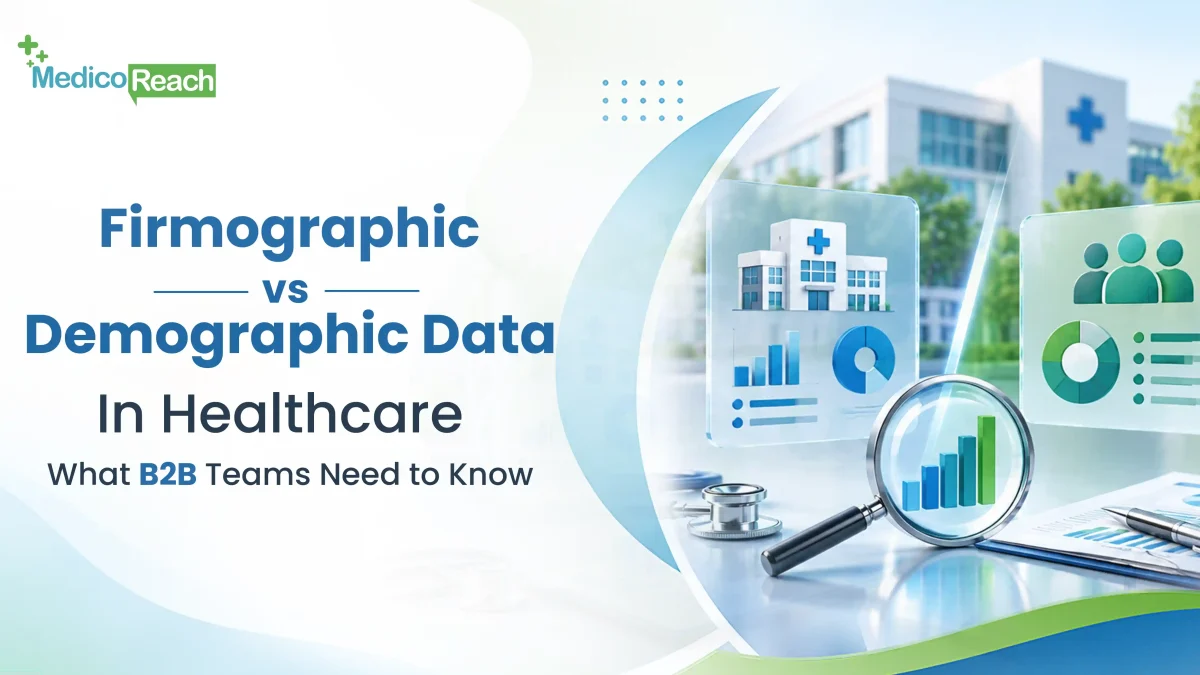
What is the secret to launching a successful account-based marketing strategy in B2B healthcare? It starts with viewing your market through a dual lens. First, you must assess a healthcare organization’s type, location, size, and financial capacity using firmographic data. Second, you must understand the professional profiles of the decision-makers within those entities by leveraging demographic data. Together, these insights can help you optimize your campaign.
Read on to understand the critical differences between healthcare firmographic data and demographic data, and get a step-by-step framework to integrate them into your workflows.
What Is Demographic Data in Healthcare B2B?
Demographic data in healthcare organizations refers to the professionals and decision-makers within them, such as chief medical officers, physicians, nurses, clinical pharmacists, diagnostic lab technologists, medical assistants, and so on. It defines who they are at work, what they do, and their professional attributes, including job title and role, department, seniority, licenses and certifications, and years of experience.
Demographic data enables segmentation and personalized outreach. For example, a medical device company can use a prospect’s clinical specialty to customize its pitch to the physician’s practice. Further, demographic data provides details and context about internal stakeholders, allowing B2B healthcare marketers to engage with those most likely to influence or make a purchasing decision.
In short, demographic data answers “who” is behind a healthcare account, helping B2B companies connect with the professionals who influence buying decisions.
What Is Firmographic Data in Healthcare B2B?
Firmographic data in healthcare refers to descriptive attributes of healthcare organizations such as hospitals, clinics, large multi-specialty groups, ambulatory or outpatient facilities, nursing homes, pharmaceutical companies, medical device manufacturers, and contract research organizations (CROs). It includes facility type, specialty type, ownership, employee and provider size, bed size, patient volume, location, revenue range, and more.
Healthcare firmographic data is highly fragmented due to complex ownership structures, inconsistent taxonomy, and siloed healthcare organization data. However, healthcare firmographics are critical for identifying ideal clinical accounts.
This data helps B2B teams develop personalized campaigns, identify emerging industry patterns, evaluate financial risk, and reach key decision-makers.
Firmographic vs. Demographic
Let’s take a look at the key differences between firmographic data and demographic data in healthcare:
| Parameters | Healthcare Firmographic Data | Healthcare Demographic Data |
| Object of analysis | Healthcare organizations or facilities. | Individual professionals. |
| Targeting Objective | Which organizations should be our target? | Which individuals should be targeted? |
| What it measures | Size, structure, and revenue of a business. | Job roles, responsibilities, and attributes of an individual. |
| Data fields | Type of Facility, Number of Facilities, Locations, Beds, Ownership, Parent Organization, Annual Turnover, Specialization, Patient Volume, Technology Stack, Accreditations, Certifications, and Funding Status. | Job title, Department, Seniority, Decision-making Authority, Clinical Specialty, Subspecialty, Years of Experience, Professional Credentials, Degrees, Licenses, Certifications, Areas of Expertise, and Research Interests. |
| Sources | Government healthcare databases, financial reports, and company registries. | Professional networks, surveys, and registration forms. |
| Business Applications | Account segmentation, Account-based marketing, and Market analysis. | Personalized outreach, Relationship mapping, and Data identity verification. |
| Illustrated examples | 500-bed nonprofit hospital | Chief Medical Officer with 15 years of experience |
Why Healthcare B2B Teams Need Both
The healthcare buying process is lengthy and doesn’t involve a single buyer. It depends on the organization’s requirements, budget, technological infrastructure, purchasing processes, and policies.
The involvement of several decision-makers calls for a combination of healthcare firmographic and demographic data for accurate targeting and engagement.
Firmographic data provides detailed information about the healthcare organization. This includes facility footprint, specialty mix, organizational structure, technology infrastructure, financial performance metrics, and growth indicators. These factors enable B2B teams to build healthcare ICPs, segment markets, and prioritize territories. It also helps align account-based marketing campaigns with organizations that present lucrative opportunities.
Demographic data offers insights at an individual level. It helps teams uncover who makes up the professional workforce within a healthcare organization. This includes job titles and responsibilities, seniority, specialization, credentials and certifications, and purchasing authority.
Combining firmographic and demographic data helps paint a clear picture of a healthcare market segment. While firmographic data helps identify which healthcare systems are worth pursuing, demographic data is useful in finding out the right decision-makers within those systems.
This allows B2B healthcare marketers to improve targeting, personalize engagement, map buying committees, and build more effective go-to-market strategies.
Where Teams Go Wrong Using Only One
When B2B teams rely solely on firmographics, they secure organizational alignment on paper but fail to engage the actual buying committee.
Knowing an enterprise hospital system’s bed count, facility type, and annual revenue can help assess organizational and financial fit, but it says nothing about the internal stakeholders who are in charge of the budget.
Without demographic insights, marketing campaigns fall back on generic, institutional messaging that fails to resonate.
Marketing assets wind up targeting abstract corporate entities, routing high-value content to outdated contacts who have already exited the organization.
Conversely, relying exclusively on demographic data may attract specialized clinicians who show strong interest in your product and download every whitepaper but lack purchasing authority.
Without firmographic filtering, you miss critical information such as a frozen capital expense budget or an exclusive vendor lock-in.
Combining both layers allows sales and marketing teams to execute healthcare account-based marketing strategies that validate organizational fit and then map exact personas within buying committees. This helps them reach decision-makers at structurally relevant accounts.
How to Combine Firmographic and Demographic Data
Integrating firmographic and demographic data assists healthcare B2B companies in identifying the right organizations and the relevant stakeholders and professionals within them. Here’s a framework that can be adopted for effective targeting:
1. Define ICP and Target Accounts
Begin with your existing clientele and identify the traits of ideal accounts using firmographic data. Consider factors like facility type, size, bed count, location, annual revenue, growth stage, and technology environment.
Your healthcare ICP defines the best-fit firms or companies, while your target account list consists of accounts you want to pursue.
2. Identify the Right Stakeholders
Once you have your target accounts, establish the people involved in the buying process using demographic data. Look at their job title, seniority, department, responsibilities, and decision-making power.
For instance, a healthcare purchase can involve a chief medical officer, clinical leader, and finance executive. Mapping these stakeholders connects the organization to people who influence the purchase.
3. Clean Your Data
Eliminate duplicate or ambiguous records, and ensure every contact is linked to the right account. Standardize company names, job titles, and locations. This helps establish a clear link between the organization, its characteristics, and the professionals within it.
4. Enrich Missing Information
Fill important gaps such as missing company size, bed count, technology infrastructure, and job titles through credible and verified healthcare data sources. Focus on useful data rather than collecting information just because it is available.
5. Segment Using Both Data Types
Enrich your list using firmographic and demographic attributes for precision targeting. These segments can be further refined through intent signals in order to find companies that might currently be seeking a solution. For instance, sending a generic email to a broad list of physicians is unlikely to trigger a response; rather, target the chief medical officer at a hospital with over 500 beds who has recently shown interest in your product or offerings.
6. Customize and Measure
Leverage the combined data to personalize messaging to accommodate the organization’s needs and the individual’s role. A chief medical officer may be concerned about the health outcomes of the facility, while a CFO prioritizes the financial impact. Measure engagement at both the account and stakeholder level.
Conclusion
In conclusion, breaking through the healthcare market necessitates a comprehensive picture of your target accounts. Healthcare firmographic data helps you identify appropriate institutions based on location and organizational structure. Meanwhile, demographic data provides the human context to connect with the people behind these institutions. When you bring these two layers together, you can engage directly with decision-makers in the best-fit healthcare organizations for maximum conversions.