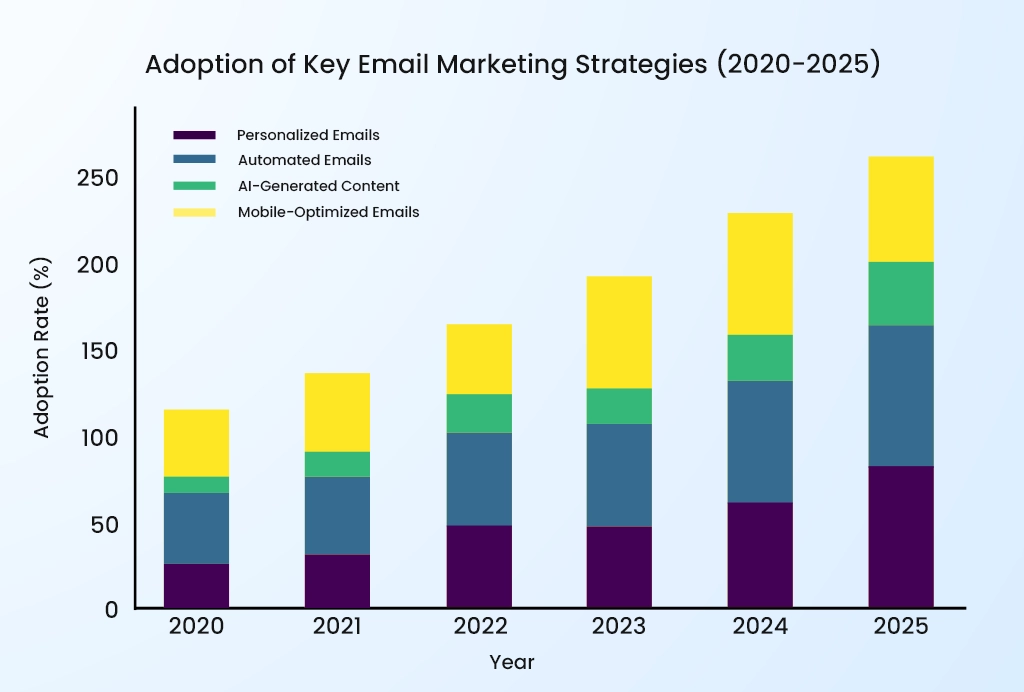
In this digitalized world, swift technological innovations such as artificial intelligence, machine learning, automation, data analysis platforms, and data privacy regulations are transforming the healthcare email marketing landscape. The growing adoption of AI platforms such as ChatGPT, Gemini, Perplexity, Copilot, as well as AI-driven email marketing tools, is automating various aspects of healthcare email marketing, including content selection, data segmentation, send-time optimization, email campaign automation, and reporting and actionable analytics. As a result, marketers are refining email marketing strategies to pitch their offerings to targeted physicians, nurses, dentists, IT and procurement leaders, C-level executives, and other key decision-makers across the healthcare industry.
Many studies highlight that for every $1 invested, email marketing delivers an impressive average return of $36. This is precisely why it is the most effective digital channel for higher return on investment (ROI). Unlike disjointed or outdated marketing methods, email ensures that your personalized messages reach the right prospects’ inboxes at the right time.
But do you know what exact strategies you need to follow to generate qualified leads from each email campaign? No worries we’re here to help you. In the B2B healthcare industry, innovation and trust are non-negotiable. If you fail to follow the ethical marketing approach, it can lead to compliance issues, lost leads, and poor outcomes. Therefore, go through this end-to-end guide that will enhance your knowledge of key healthcare email marketing trends, types, strategies, steps, the future outlook, and more.
Why Does Healthcare Email Marketing Matter?
Healthcare businesses use email marketing to effectively communicate with large numbers of professionals and decision-makers in the industry. Unlike traditional marketing strategies like cold calling, direct mailing, etc., email marketing is scalable and effective.
If you’re a b2b healthcare marketing professional, leverage email marketing to:
- Directly market to healthcare decision-makers (physicians, dentists, C-level executives, procurement head, and administrators)
- Announce your newly launched IT solutions or medical devices along with the detailed features, integration guides, and client testimonials.
- Include product or service demos and ask for feedback to increase engagement.
- Share upcoming events or webinar links directly to the prospects’ inboxes without directing them to other pages.
- Share updates on healthcare technological innovations and policy changes, and other valuable information through educational content.
- Promote job openings and find talented candidates based on their expertise, years of experience, practice locations, and more criteria.
- Get high response rates from prospects and secure qualified leads that easily convert.
What are the Current Trends Shaping Healthcare Email Marketing?
Email marketing in B2B healthcare is all about sending emails tailored to each target audience’s needs and maintaining safer and inclusive communications to generate qualified leads.
In this section, we’ve discussed some key trends shaping healthcare email marketing. Marketers need to incorporate these trends to make a winning strategy.
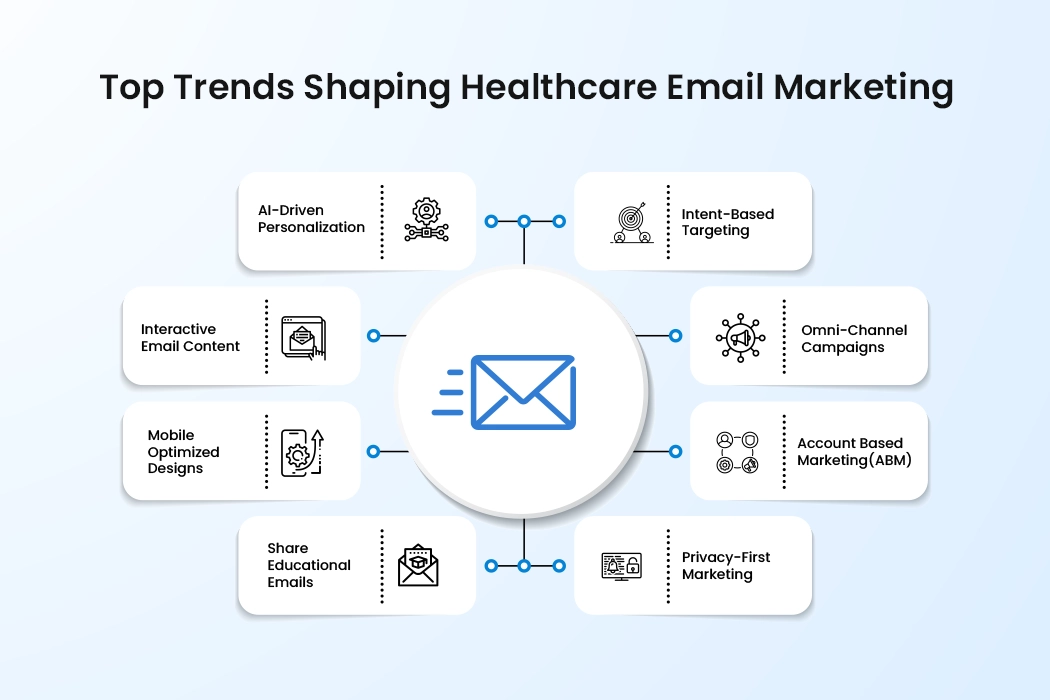
- AI-Driven Personalization
Artificial intelligence enables highly personalized email content tailored to the specific needs, roles, and interests of healthcare audiences. This AI -powered tool not only personalizes the email content but also customizes the subject lines, professional tones, and timing, by analyzing the user behavior and previous interaction history.
The combination of predictive AI and generative AI personalizes, optimizes, and automates the healthcare email marketing process. Predictive AI provides in-depth insights assessing historical data, and generative AI uses that information to craft relevant, bespoke content to user needs at speed and scale.
“AI-driven email marketing can increase revenue by 41% and improve click-through rates by 13%.”
- Intent-Based Targeting
Rather than focusing on demographic information or job titles, intent-based marketing helps sales executives to analyze their prospects’ real-time behavior, purchase history, and active interest signals. Based on b2b buyer intent data, they can send automated emails that generate qualified leads.
- Interactive Email Content
If you want your emails to easily stand out in crowded inboxes, interactive emails are the best choice. It instantly captures intended prospects’ attention and keeps them engaged in your business.
Adding interactive elements such as embedded videos, surveys, charts, or modular content breaks down complex topics and guides the target audience to understand which products or services can resolve their challenges.
- Omnichannel Campaigns
In this digitalized world, b2b healthcare email marketing has been successfully extended to Omnichannel integration, such as social media platforms, SMSs, websites, or other relevant apps. This strategy ensures that organizations are sending consistent messages to their clients across multiple touch points.
For example, if any healthtech company maintains its daily communication across the websites, social media apps, and more, it gradually increases its brand loyalty.
- Align with Account Based Marketing (ABM)
In the coming years, an effective ABM strategy will no longer be an optional element because a one-size-fits-all approach fails to precisely target. AI-powered predictive analytics tools can help you examine market trends and past behavior to identify which accounts are more likely to engage and convert into sales. Then, send them personalized email content that directly speaks to their specific interests and challenges.
- Implement Privacy-First Marketing Strategies
As data privacy regulations continue to evolve, privacy-first marketing has become a critical trend in B2B healthcare email marketing. Healthcare marketing databases primarily contain professional contact information, making compliance with regulations such as GDPR, CCPA, and CAN-SPAM essential. Organizations are increasingly adopting opt-in data practices, transparent data usage policies, and secure data management frameworks to protect contact information and maintain trust.
Encryption, access controls, and regular data audits help reduce risk and strengthen compliance, while privacy-focused messaging ensures ethical outreach. By prioritizing data protection and regulatory alignment, healthcare marketers can improve deliverability, safeguard brand reputation, and build long-term credibility with healthcare professionals.
- Share Educational Emails
If you always send emails to your prospective clients just for selling purposes, most of your emails will be marked as spam and spoil your brand reputation.
In this digital era, most healthcare professionals search for product or service information online, so it is highly recommended for marketers to deliver product features or demos directly to their inboxes that grab immediate attention.
Incorporating educational content, like new technological innovations in healthcare, recent healthcare policy changes, etc., also increases the interest of clients in your brand.
“Educational emails achieve higher click-to-open rates (CTORs) ranging from 20% to 30%.”
- Mobile-Optimized Designs:
A recent study suggests that 81% global population uses smartphones to check their emails. Moreover, 70% professionals practice in healthcare sector daily check their relevant emails on smartphones.
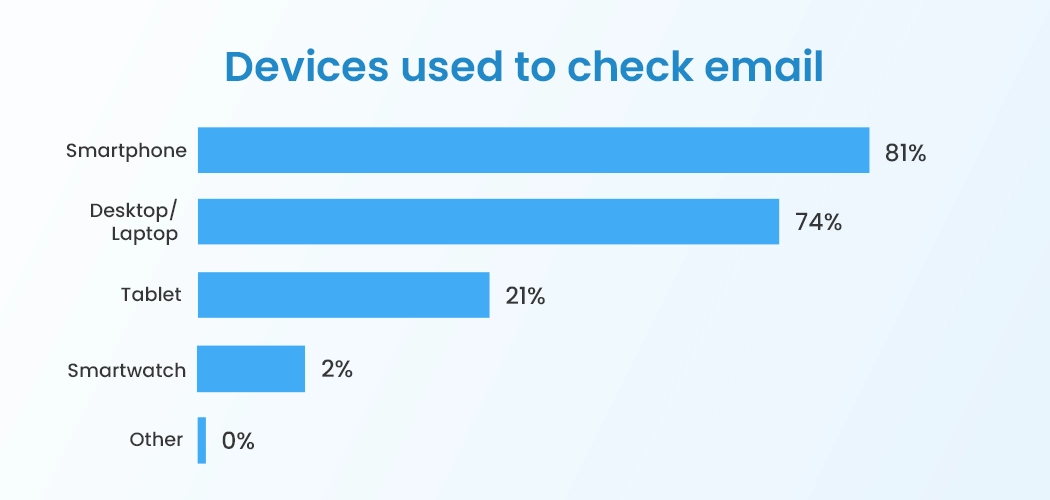
Mobile-unfriendly design, such as poor formatting, slow load time, etc., leads to miscommunication and an impact on pipeline performance. This is the key reason Health Tech and SaaS providers are prioritizing mobile-friendly design, readable fonts, and minimal load times before sending personalized emails to their prospects.
What Makes Healthcare Email Marketing Different from Other Marketing Strategies?
Here are major reasons that set email marketing in healthcare apart from other outreach strategies:
| Key Factor | Healthcare Email Marketing | Other B2B / General Marketing |
| Regulatory Environment | Must align with healthcare-relevant regulations such as GDPR, CCPA, CAN-SPAM, and HIPAA where applicable, with strong emphasis on responsible handling of professional contact data. | Typically follows general data protection laws with fewer industry-specific compliance considerations. |
| Privacy-First Approach | Privacy-first marketing is essential, with transparent data usage, compliant outreach methods, and secure data management to build trust with healthcare professionals. | Privacy is important but often less restrictive and easier to manage. |
| Content Focus | Strong emphasis on education, insights, and value-driven communication rather than direct promotion to establish credibility. | More promotional messaging is commonly accepted. |
| Personalization Strategy | Personalization is role-based and specialty-specific, focusing on relevance, brevity, and professional context. | Often relies on basic personalization such as name or company. |
| Audience Behavior | Healthcare professionals have limited time and high information overload, requiring concise and highly targeted emails. | Audiences generally have more flexibility to engage with longer or frequent messaging. |
| Decision-Making Process | Involves multiple stakeholders such as clinicians, administrators, and procurement teams, resulting in longer sales cycles. | Often driven by fewer decision-makers with shorter sales cycles. |
| Trust & Credibility | Trust is critical; brands must demonstrate expertise, reliability, and ethical communication practices over time. | Trust is important but typically easier to establish through promotional proof points. |
| Provider Burnout Consideration | Campaigns must respect workload pressures and focus on relevance to avoid fatigue and disengagement. | Burnout is less industry-specific and not a primary constraint. |
What are the Types of B2B Healthcare Email Marketing Campaigns?
Below, we’ve explored the key types of email marketing campaigns that help healthcare companies and marketers stand out from the competition and achieve tangible benefits.
Let’s have a quick look at these types:
- Cold Outreach Emails:
Cold outreach emails are a common type of healthcare email campaign, but they require strict attention to data privacy, compliance, and message relevance. These emails are typically targeted to specific roles, such as procurement managers, IT leaders, clinicians, and other decision-makers.
Effective cold outreach avoids exaggerated claims, clearly communicates the message’s purpose, and adheres to region‑specific regulatory guidelines to ensure ethical, compliant communication.
- Nurture Campaigns:
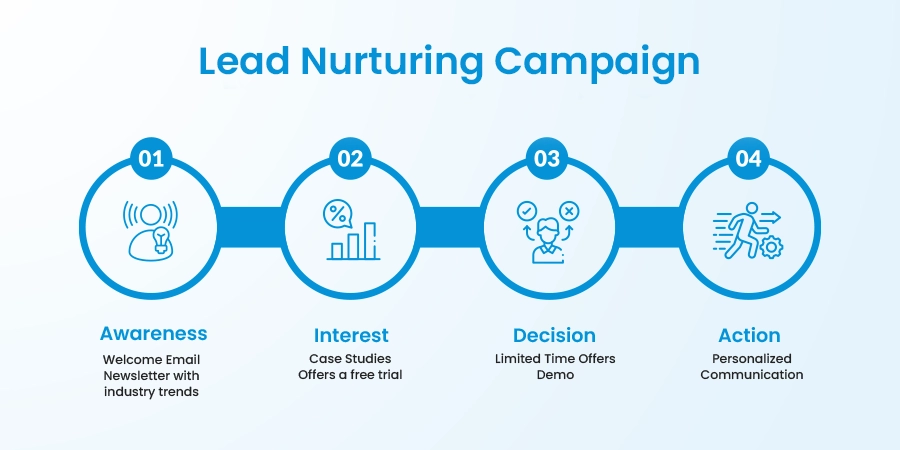
Nurture campaigns are most effective for leads who are not yet ready to engage or make a purchase. Instead of sending all information at once, healthcare organizations deliver a steady flow of valuable content, such as educational email sequences, industry trends, policy updates, clinical research, and client success stories. These messages help build trust, keep the brand top‑of‑mind, and guide prospects through the decision‑making process until they are ready to take the next step.
- Newsletters Emails:
Newsletter emails are an effective way to stay top‑of‑mind with prospective clients. Educational and informational newsletters help nurture long‑term relationships, build rapport, and support stronger engagement over time.
In the healthcare sector, newsletters often include research insights, technological advancements, regulatory updates, and emerging industry trends, providing valuable information that positions the organization as a trusted thought leader.
- Promotional or Lead Generation Emails:
Promotional or lead‑generation emails are an important component of B2B healthcare prospect engagement. These emails are concise, compelling, and include clear calls to action (CTAs) that encourage healthcare professionals to take the next step. The content is tailored to address the prospect’s specific needs and demonstrate value.
Healthcare marketers use these emails to highlight product or service features, benefits, upcoming offers, and relevant educational resources, all while maintaining accuracy and compliance with industry guidelines.
- Product/Service Update Emails:
Product or service update emails are an important part of a comprehensive prospect engagement strategy. These emails provide a direct channel for sharing new features, enhancements, upcoming product launches, and system improvements. By consistently informing prospects about ongoing advancements, healthcare organizations demonstrate their commitment to delivering a reliable, high‑quality experience.
- Conference, Event, and Webinar Emails:
Conference, event, and webinar emails are essential for engaging healthcare stakeholders who seek ongoing education and professional development. Healthcare professionals regularly attend webinars, conferences, and training sessions to stay updated on industry advancements.
CME providers, training institutions, and healthcare researchers use targeted email invitations to promote these events, share key details, and encourage registration among relevant prospects.
What are the Key Steps involved in Healthcare Email Marketing?
Just like your prospective clients, your time and effort are also precious. If you’re looking to target top-tier decision-makers in the competitive healthcare industry, go through each step mentioned below to get the desired outcomes from email campaigns.
Step 1: Define Your Target Audience
First, decide who your exact target audience is and set your clear goals. Product or service purchase decisions in the dynamic healthcare industry do not depend on one single stakeholder. The purchasing decisions sometimes take multiple stakeholders, like the administrative head, physicians, surgeons, nurses, or healthcare executives. Each role has different preferences, responsibilities, and challenges.
Additionally, segmentation by medical specialty, care setting, organization type, and decision-making authority is critical. Clearly defining who the email campaign is meant for ensures the messaging remains relevant, personalized, and aligned with real healthcare buying behavior.
Step 2: Build or Source a High-Quality Healthcare Email List
Once the target audience is defined, the next step is to build or source high-quality email addresses. In B2B healthcare marketing, data quality has a direct impact on campaign performance, deliverability, and compliance.
A reliable healthcare email list should include verified professional email addresses, accurate job titles, specialty-level classification, and regular updates to reflect job changes or role transitions. Lists validated through NPI or professional credentials help improve accuracy and trust.
Using clean, compliant, and well-segmented data reduces bounce rates, improves inbox placement, and ensures outreach reaches the right healthcare decision-makers.
Step 3: Segment and Personalize Email Campaigns
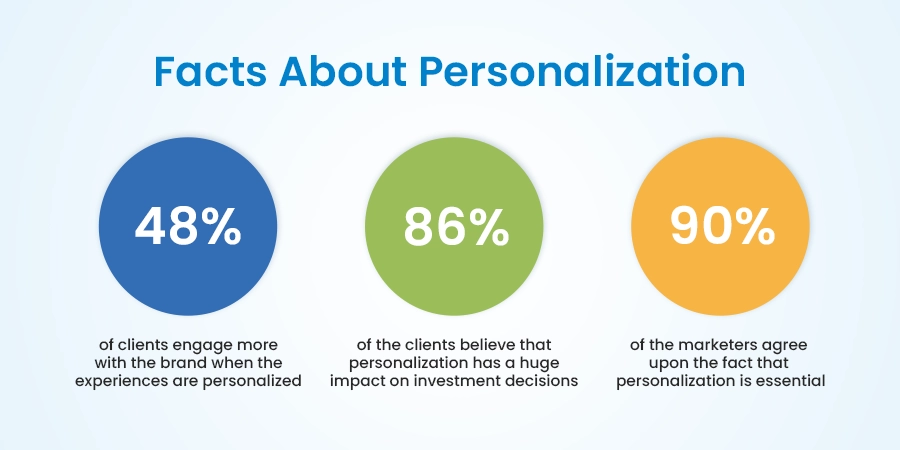
No two audiences’ preferences are alike in healthcare. Healthcare professionals receive large volumes of messages, making relevance a key factor in engagement. For example, the priorities of physicians are vastly different from hospital procurement managers. That’s why you should segment your audience based on job specialties, locations, organization sizes, and other criteria.
Based on prospects’ behavior patterns, purchasing history, and engagement rates, AI-driven email marketing platforms (such as Brevo, GetResponse, and others) automatically segment contacts. These platforms offer dynamic workflows that trigger automated journeys when readers open any link and download the free guide. Many also incorporate predictive analytics to deliver personalization at scale.
A leading marketing automation platform, Marketo, organizes the target audience into groups based on similar characteristics, such as geography, engagement, behavior, or firmographic attributes.
Step 4: Craft Value-Driven Content
Content plays a crucial role in building trust in healthcare email marketing. Decision-makers in the healthcare don’t like listening to sales pitches; they look for solutions that can help them overcome their current challenges. Here, value-based, personalized content comes into play.
Before delivering emails to your target audience, ensure the content is relevant, personalized, and aligned with their current needs. Healthcare marketers should craft emails that highlight product or service value based on audience requirements and roles. AI-powered tools such as ChatGPT, Gemini, and similar platforms can help create multiple email variations and subject lines, enabling marketers to customize messaging effectively for different audience segments.
Step 5: Build Automated and Multi-Step Email Workflows
Single emails are rarely effective in B2B healthcare due to long sales cycles and complex buying committees. Automated, multi-step email workflows allow marketers to nurture leads over time with consistent and relevant communication.
These workflows may include introduction sequences, educational drip campaigns, event follow-ups, and re-engagement emails. Automation also enables adaptive messaging based on recipient behavior, such as opens or clicks, helping maintain relevance throughout the buyer’s journey.
A recent study highlighted that AI-automated emails, such as those triggered by user sign-ups or requests for a proposal, have the potential to generate 320% more revenue than traditional email marketing campaigns.
Step 6: Email Deliverability Optimization and Maintain Compliance
Email deliverability is a critical factor in healthcare marketing, where inbox providers apply stricter filtering standards. Optimizing deliverability involves maintaining clean lists, authenticating sending domains, warming up new email domains, and monitoring bounce and spam complaint rates.
Compliance with data protection regulations such as GDPR, CCPA, and CAN-SPAM is equally important. Clear sender identification, transparent messaging, and easy opt-out options help maintain trust and protect sender reputation.
Strong deliverability and compliance practices ensure that emails consistently reach healthcare inboxes and support long-term campaign success.
Step 7: Measure Campaign Performance
The final step in a successful B2B healthcare email marketing strategy is measuring performance and making continuous improvements. Key metrics such as open rates, click-through rates, response rates, and conversion rates help marketers understand how different audiences and specialties engage with email content.
Comparing campaign results against industry standards allows teams to identify performance gaps and improvement opportunities. Referring to healthcare-specific email benchmarks provides valuable context when evaluating results, helping marketers set realistic expectations and optimize campaigns based on proven industry data.
Continuous testing of subject lines, messaging, send times, and calls-to-action ensures ongoing improvement while maintaining compliance and deliverability across healthcare audiences.
High-impact Strategies Useful for B2B Healthcare Email Marketing
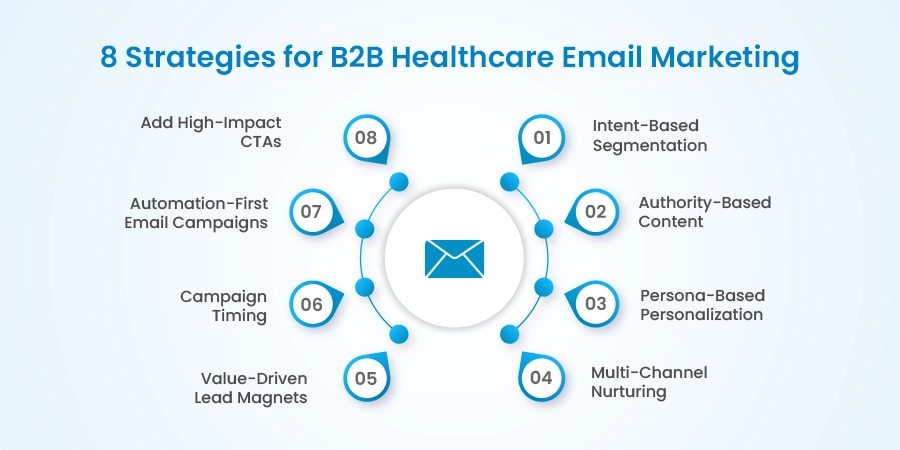
A recent study found that 83% B2B marketers consider email as their most effective communication channel. The healthcare marketers are no exception. The well-orchestrated healthcare email marketing strategies can help you accelerate your sales pipeline and get the highest responses from each email campaign.
Let’s dive into these strategies:
- Intent-Based Segmentation
If you want your emails to be opened and clicked by your targeted prospects, intent-based segmentation is the ultimate solution. Analyzing the real-time purchasing intent, message consumption patterns, behavioral data, and previous buying history, you can send highly customized content and get a higher open and click-through rate.
- Authority-Based Content
In the rapidly evolving healthcare sector, every professional has unique needs and choices. Authority-based content is crafted based on the decision-making power of the target audience. The messages can be customized for the IT and procurement head, C-level executives, clinicians, or departmental heads.
- Persona-based personalization
If your target audience is Chief Medical Officers, Chief Financial Officers, or the IT head, analyze their detailed profiles. Then, evaluate their pain points or what solutions they are looking for. Then, craft the personalized emails to boost engagement with them.
- Multi-channel nurturing
Integrate your targeted email campaigns with other platforms such as webinars, retargeting ads, calls, direct mail, LinkedIn, or more. This approach allows the audience to gain a seamless experience.
- Value-driven lead magnets
Before creating a lead magnet, identify some specific challenges of your prospects. Then, offer them the solution that captures their immediate attention. In this way, you can build trust in their mind and continue lasting relationships.
- Campaign timing based on prospects’ schedules
The healthcare professionals often have unpredictable schedules. Respect their busy workday and adjust your campaign time to their convenience.
- Automation-first email campaigns
Conduct automation first, and pre-build email campaigns that automatically deliver personalized emails to the target audiences’ inboxes when they take any action.
- Add high-impact call-to-actions (CTAs)
Add high-value and action-oriented CTA buttons and links at the end of the email. The CTAs can be strategically placed within the email’s narrative flow.
What are the Best Practices for Effective Healthcare Email Marketing Campaigns?
If you’re looking to leverage email campaigns in the most effective way, dive into this section below, as we’ve discussed healthcare email marketing best practices:
- Avoiding Clinical Claims: When you’re directly communicating with healthcare decision-makers, it is highly recommended to avoid therapeutic claims such as unverified medical statements, claims about patient outcomes, or suggestions of treatment superiority. The email content needs to be informative, research-based, and market-trend-based.
- Compliance Filtering: The filtration of data compliance ensures that your emails comply with both local and international data privacy and security guidelines such as GDPR (EU), CAN-SPAM, and CCPA. Compliance filtering emails include role-specific, clear opt-out, and consent-based data.
- Shorter Content Integration: Healthcare professionals have limited time and demanding work schedules. Therefore, they ignore lengthy bulk emails and look for short, easy-to-read content. Best practices include adding clear and concise paragraphs, highlighting the purpose in the first 1-2 lines, and using spacing and bullet points.
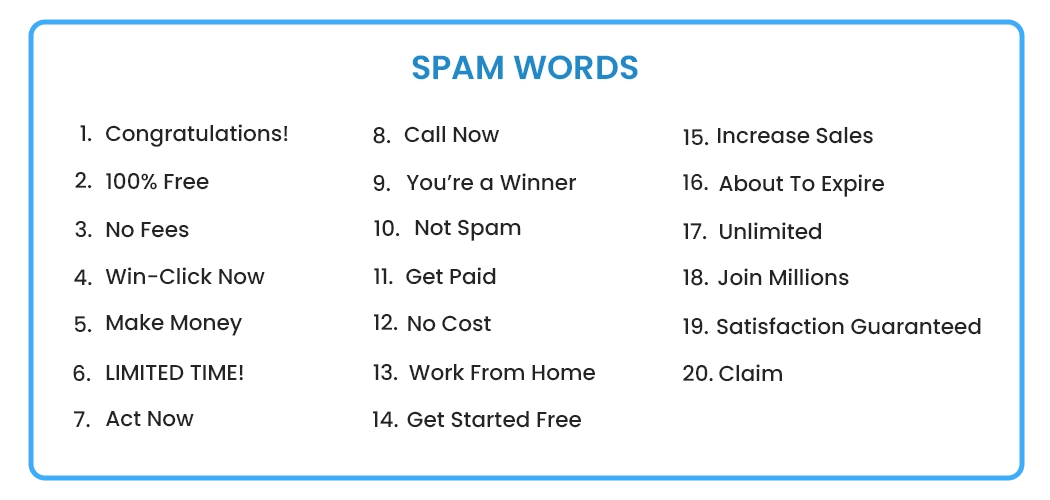
- Avoid Spam Triggers: With nearly 6% of emails worldwide being considered spam, it is clear that the quality of your subject line is more important than ever. Crafting a subject line and content that is free from spam triggers and focusing on quality over quantity are key parts of healthcare email marketing.
- Use Unique Domains: It is highly recommended to use a unique sender domain to safeguard the main website, reduce the risk of primary domains, improve brand reputation, and increase the email deliverability rate. To make it happen, a proper DNS setup, such as SPF, DKIM, and DMARC, is needed.
- Customized Subject Lines for Different Specialties: Before sending emails to your intended audience’s inboxes, make sure your email subject line is highly relevant, personalized, not generic, and tailored to their current needs. If you provide the right email content, the possibility of selling products or services also increases, as your brand will come to mind first when clients make purchasing decisions.
What are the Most Common Mistakes Healthcare Marketers Should Avoid?
Sometimes, healthcare sales and marketing executives fall into certain traps that diminish their campaigns’ effectiveness, frustrate the target audience, and violate regulatory compliance.
Here, we’ve explored some common mistakes that happen in healthcare email marketing:
- Ignoring data-compliance guidelines: Neglecting the data privacy and security protocols (such as CCPA, GDPR, and more) is a common mistake most marketers make. Violating these regulations often results in severe legal and financial penalties, as well as loss of trust.
- A lack of personalized approach: Personalization is no longer optional; it is now mandatory in email marketing. Without knowing the exact pain points and preferences of the ideal audience, healthcare marketers send generic emails to them that are marked as spam.
- Overload with medical jargon: Not all healthcare decision-makers may be familiar with complex medical terminology. As a result, it can lead to lower audience engagement and missed opportunities.
- Deliver bulk emails: Some healthcare companies make the mistake of sending too many emails at a time. Prospects flag those emails as spam and click the unsubscribe options, which damages the sender’s reputation.
- Fail to optimize for mobile devices: Nowadays, half of healthcare professionals open emails on their mobile devices. Therefore, if you fail to optimize your email campaigns for mobile devices, you’ll miss out on potential opportunities.
- Neglect to add CTAs: Each email should have a specific purpose and guide the recipients to take the next initiative. As a result, if CTA buttons are not added in emails, your target audience will lose interest in connecting with you further.
- Not A/B testing the email campaigns: If you’re not experimenting with different content layouts, CTAs, send times, or subject lines, start doing so. Because without knowing what email campaigns will work best, you’ll lose qualified leads.
- Maintain email list updating: Over time, email databases naturally accumulate outdated contact information, inactive email IDs, and more. Therefore, updating every 90 days ensures all email addresses are up-to-date.
Key Performance Indicators (KPIs) to Measure the Success of Healthcare Email Marketing
The objective of measuring KPI is to evaluate how much you spend on your email marketing campaigns and what you’ve received in return. Here’s a glimpse of key KPIs that are useful to measure the success of email marketing for health care and increase Return-on-Investment (ROI):
| Sl.no | Key Performance Indicator | What it Measures |
| 1 | Open Rate | It is the percentage of emails are opened.
Calculation: (Opens/Delivered Emails) |
| 2 | Deliverability Rate | It is the percentage of email delivered.
Calculation: (Number of sends – Number of bounces/Total Number of sends) |
| 3 | Click Through Rate (CTR) | It is the percentage of clicks any links on the email.
Calculation: (Clicks/Delivered Emails) |
| 4 | Conversation Rate | It is the percentage of email openers who completed desired action (Book a Demo, Signup) |
| 5 | Bounce Rate | It is the percentage of messages rejected by the email client.
Calculation: (Bounces/Sends) |
| 6 | Unsubscribe Rate and Compliant Rate | It is percentage of recipients unsubscribing per delivery. |
| 7 | Click-To-Open-Rate (CTOR) | Content relevance of those who opened, how many found the content compelling enough to click.
Calculation: (Unique Clicks/ Unique Opens) |
| 8 | Spam Compliant Rate | Higher spam-compliant rates impact the deliverability rates and the sender’s reputation.
Calculation: (Spam Complaints/Delivered Emails) |
| 9 | Social Sharing Rate | How often recipients share your email content on social platforms.
Calculation: (Social Share Clicks/ Delivered Emails) |
| 10 | List Growth Rate | How fast your email list is growing (or shrinking).
Calculation: (New Subs−(Unsubs+Complaints)Total List Size) |
| 11 | Forwarding Rate | High forwarding rates are like a pat on the back for your Content. They indicate that recipients found value in your emails. |
| 12 | Event Lag | How long it takes for recipients to engage after the email is sent.
Calculation: (Event Date/Send Date) |
Here’s are the Technology Stack for B2B Healthcare Email Marketing
A robust technology stack integrates many components that help you reach your target audience without hurdles and streamline your prospecting efforts. Such a technology stack includes:
- Automation Tools:
If you’re willing to nurture your leads, send follow-up emails on time. Maintaining personalized communication through automation tools is the best choice for your email campaigns.
Examples: HubSpot Marketing Hub, Marketo Engage, Pardot (Salesforce Marketing Cloud Account Engagement), Mailchimp
- Customer-Relationship-Management (CRM) Systems:
A CRM system offers a unified view of each account or contact. You can easily track your prospect’s preferences and communication history with certified healthcare physicians, nurses, and others.
Example: Salesforce Health Cloud, Microsoft Dynamics 365, HubSpot CRM, Zoho CRM
- Email Verification & Validation Tools:
Healthcare sales and marketing executives can use these tools to verify the accuracy of each email address. It ultimately protects data and enhances the sender’s reputation.
Example: ZeroBounce, NeverBounce, BriteVerify, Clearout
- Data Enrichment & Healthcare Intelligence Tools:
If you want your campaigns to reach the right healthcare professionals, enriching your data is essential. These tools help you enhance contact records with accurate specialties, job roles, and organization details. With enriched data, your email campaigns become more targeted, relevant, and effective.
Example: Definitive Healthcare, IQVIA, ZoomInfo, Apollo.io, Kipplo
- Analytics & Performance Tracking Tools:
Implementing these tools helps you to measure the email campaign performance and align it with your business objectives. You can understand which strategies are working best and which need more improvement.
Example: Google Analytics 4, Tableau, Power BI, Looker Studio
Future Outlook for the B2B Healthcare Email Marketing Campaigns
Let’s have a look at the future outlook of healthcare email marketing that will blend advanced technological innovations with high-value personalized content to increase engagement:
- Predictive audience scoring helps healthcare marketing professionals to understand how much and what type of nurturing each lead actually requires. It helps them to integrate those leads into future lead-nurturing email campaigns and send personalized content.
- Autonomous AI-campaign builders combine data analytics and machine learning algorithms that automatically manage the entire lifecycle of any email campaign. From strategy execution to real-time performance analysis, this intelligent software system minimizes human efforts.
- Zero-party data emphasis ensures that prospects intentionally shared their details with a particular brand. With a strong focus on data privacy and security protocols and the deprecation of third-party cookies, zero-party data will be incorporated into email campaign strategies for pinpoint accuracy.
- Real-time behavioral segmentation aligns your personalized messages with the prospects’ interests, resulting in high engagement rates. Thus, you can build lasting connections with your target audience and boost return on investment (ROI).
Final Thoughts
Email marketing remains one of the most effective and dependable channels in the B2B healthcare landscape, especially as data privacy requirements, longer sales cycles, and complex buying committees continue to shape how healthcare organizations evaluate solutions. When built on accurate, compliant data and enhanced by AI-driven segmentation, personalization, and structured lead-nurturing workflows, healthcare email marketing becomes a powerful way to engage the right decision-makers at the right time.
Also the integration of generative AI, intelligent automation, and modern AI-powered email marketing platforms enables healthcare marketers to scale relevance, improve efficiency, and deliver timely, role-specific messaging while maintaining compliance and trust.
By applying the strategies and best practices outlined in this guide, healthcare marketers can improve engagement, protect deliverability, and drive qualified opportunities while building long-term, sustainable growth.